Wednesday, 24 August 2011
Joey - The Horse Who WAS Scared of Bicycles
Joey's owner has been kind enough to let me put this video of him on my blog. He's a great little horse, but he had a fear of bicycles, which was proving a bit tricky with the spring and summer hacking along the country lanes.
Bicycles are just one of the many things we can help with fears and phobias of. We use, and teach equine owners, special techniques to help turn their horse's fear into curiosity. Horses are naturally very curious creatures. By engaging this curiosity, and by understanding and working with the psychology of the horse and knowing how they learn, we can help them overcome their fears.
Joey was scared of bicycles before our training session. This video taken part way through the session shows how our techniques had started to engage his curiosity in them. Our training uses a "step by step" process, helping the horse or pony build confidence every step of the way. By the end of the session, Joey was able to have bicycles come past him from the front or behind along the country lanes.
Joey's owner has been keeping up with his training and they are doing brilliantly. As well as being OK about bicycles now when they are out hacking, Joey has also gained confidence with mopeds. His owner used the same techniques with a horse lorry and Joey being curious about it eagerly loaded himself into the lorry.

Sunday, 21 August 2011
Rebel - The Difficult to Catch Horse
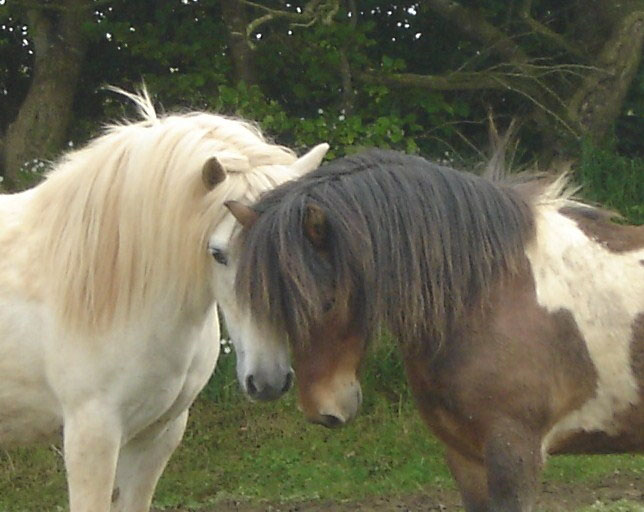
 The horse in the right of the photo is Rebel - a rather handsome Warmblood. Rebel has a very interesting problem, in that he is afraid of being caught in the field. He originally came from the Continent and has always been known for his catching problem, which had led to some previous owners being reluctant to give him any turnout at all.
Rebel's owner has been able to work out a system to make sure that Rebel can have his needs (such as having the farrier, or vet) seen to, but her aim is to be able to catch Rebel in the field. On our first session, Faye was able to make contact with Rebel - using non-confrontational body language techniques, she was able to get Rebel to be happy with her stroking his face and head in the field. It took an hour...but this was the first time Rebel has been touched in the field for at least 7 years. There's a lot of previous history to undo, and Faye really had to prove to Rebel that she, as a human, is not a threat to him. At the moment we are concentrating on rebuilding Rebel's trust in people when he's being caught...hopefully it won't be too long before his owner is able to interact with him in this way too. Rebel's owner has been brilliant at understanding his problems and giving him as much time as he needs to build positive experiences.
Sunday, 7 August 2011
Equine Body Language and Behaviour Weekend
We had another very successful weekend course - it seems that choosing to make this a weekend course was ideal, as it gives a chance for plenty of equine observation, as well as "hands-on" interaction. We spent half a day on Dartmoor observing a few of the wild herds with mares, stallions and foals. The following day, we were based back at Horseford Farm and had a really good opportunity to learn about how to move/herd horses, as well as looking at catching and leading, and seeing what a big affect our human body language has on the horses.
Again, we had excellent feedback ratings for all the aspects of the course. Here's some of the feedback:
"Practical sessions were safe and controlled. The support Faye gave was excellent, in both practical and theory sessions. I found myself seeing horses in a completely different way and even re-thinking of past situations which made me think "of course, that's what they were trying to tell me"! Faye and the horses were brilliant teachers".
Again, we had excellent feedback ratings for all the aspects of the course. Here's some of the feedback:
"Practical sessions were safe and controlled. The support Faye gave was excellent, in both practical and theory sessions. I found myself seeing horses in a completely different way and even re-thinking of past situations which made me think "of course, that's what they were trying to tell me"! Faye and the horses were brilliant teachers".
Monday, 27 June 2011
Horse Handling For Beginners
 We received excellent feedback for our course "Horse Handling For Beginners" which we ran on 25th June. On this course we cover the fundamentals of handling horses from headcollaring and picking out hooves, to grooming and leading, as well as learning to read basic horse body language. There's just so much to include in a day, we could probably turn this day into a weekend course!
We find that beginners pick up techniques and build confidence very quickly - and it's great to send participants out into the world with a good solid foundation of skills to build on. We always emphasise that once people leave our courses, it's really important for them to find some equines to practice with that are suitable for their skill level...it's really important to set yourself up for success!
Course Feedback: We had excellent ratings from participants for the quality of the teaching, the theory content, the practical tuition, the course handouts, the suitability of the ponies, and the overall experience.
"Really enjoyed the teaching style and material. Found as an essential introduction to horse handling".
Monday, 6 June 2011
Equine Body Language and Behaviour Weekend
 This weekend we had lovely weather for our Equine Body Language and Behaviour Weekend course. One of the highlights of the course for participants was going out to Dartmoor to observe the "wild" ponies in action. On 4th June (by coincidence and perfect for our course) there was a pony sale being held at Chagford, so we were able to visit the sale to look at how horses "cope" under stress, and the different stress behaviours and body language they exhibit.
After the sale, we headed out onto the moor to visit some of the wild herds that Faye is familiar with. The weather was so good that we could sit out on the moor for the teaching. This meant we could go through some of the theory...and being sat in amongst the herds we could observe the stallions, mares and foals and how they interact with each other. Our feedback showed that one of the aspects that the students most enjoyed was looking at how Faye handled a situation where a mare was trying to join in with our lunch! A pot of flapjacks were proving somewhat irresistible for her, and Faye showed how you can clearly "say no" but without scaring the pony. The mare stayed around us for some time - not trying to take any food but was almost joining in with the course teaching.
On the second day of the course we were based back at the farm with the people4ponies equines. Students started to look at how their own body language affects horses and they were able to interact with loose equines as well as directly handling/leading them...and students could see how the behaviour they saw with the wild ponies the previous day directly relates to domestic equines. We were also able to look at the differences between traumatised and untraumatised equines.
Here's a snippet of the feedback we received for the course:
"Thank you for your excellent teaching on our intensive weekend course...I feel I have a better understanding from an equine point of view and where I should be situated as a human interacting with them. I also realise I have much to "unlearn" and an area of personal development to explore...I want to tell everyone careless to stand within conversational distance of me what I've experienced. Thanks again Faye".
Thursday, 19 May 2011
Horse Language...or Animal Language?
People often say that animals know where to go when they need help. I don't know if that's me, or whether I just have a canny ability to turn up at a point where an animal is in need of help or rescuing...anyway, recently I've noticed that when I'm interacting with these other animals (whether it's dogs, cats, or the 4th herd of cows that have wandered out into the main road and I'm the first person on scene!) that I instictively put my horse knowledge into practice...and I get the same response from the animal that I would from a horse. Many of the aspects that we cover in our horse teaching seem just as applicable to other species of animal - what we are developing is an awareness of elements that all animals relate to...
Sunday, 10 April 2011
Guide to Choosing Your Perfect Horse Course for DASH

Today we held one of our courses especially for members of the Devon Association of Small Holders (DASH). The course is perfect for anyone looking to buy an equine, a process that can seem a bit daunting, or even like a bit of a minefield...but this course is here to help - people really enjoy this course and it helps to put them at ease. We help participants to create a realistic "shopping list" to narrow down all the possibilities to the sort of equine they should be looking for on their search. Then we look at how to assess the physical, behavioural and skill elements in your potential equine...and, of course, we look at some of the pitfalls that should be avoided.
Our course participants really enjoyed their day, and we received "excellent" ratings in all elements - including the quality of the teaching, the theory content of the sessions, the practical tuition and the overall experience on the day.
This was our feedback:
"Relaxed, friendly atmosphere. Easy discussions/questions + answers. Informative, practical, realistic approach. Interested in horse pshychology/body language. Thanks, great course".
"I enjoyed the practical side - one to one and generally talking about problems. I'd like to know more about animal behaviour".
Our course participants really enjoyed their day, and we received "excellent" ratings in all elements - including the quality of the teaching, the theory content of the sessions, the practical tuition and the overall experience on the day.
This was our feedback:
"Relaxed, friendly atmosphere. Easy discussions/questions + answers. Informative, practical, realistic approach. Interested in horse pshychology/body language. Thanks, great course".
"I enjoyed the practical side - one to one and generally talking about problems. I'd like to know more about animal behaviour".
Wednesday, 2 March 2011
Laminitis Watch
Spring is well and truly upon us, and for the last 2 weeks the grass has started to shoot up. With spring arriving so early this year, lots of horse owners have already been caught out with horses and ponies coming down with laminitis.
Anyone with susceptible ponies and horses needs to start taking action now. Important steps to take are:
- Restricting grazing.
- Monitoring your equine's weight - use a weigh tape to take measurements.
- Monitoring digital pulses.
- Looking out for signs of footiness, particularly over stony ground that your horse is usually sound to cross.
- Looking for signs of lameness.
Remember that if you suspect your horse or pony has laminitis, you MUST take it off the grass. You will need to thoroughly soak hay (for at least 20 minutes, or even double soak it) to remove sugars and provide a soft surface for your horse to stand on in its stable. Wood shavings can be a good supportive surface, or you can put pads on your horse's feet to provide support. "HoofKind" feeds suitable for laminitics are available at feedstores. Seek guidance from your vet and/or farrier/barefoot practitioner who should be able to advise you on treatment and whether you should administer pain relief. Your equine will need to be kept off the grass until they have recovered, and then grazing will need to be carefully managed.
You might like to consider some of our Understanding Horses courses this year, being run in conjunction with a vet, that can help with preventative medicine and how to manage laminitics through feeding and nutrition.
Anyone with susceptible ponies and horses needs to start taking action now. Important steps to take are:
- Restricting grazing.
- Monitoring your equine's weight - use a weigh tape to take measurements.
- Monitoring digital pulses.
- Looking out for signs of footiness, particularly over stony ground that your horse is usually sound to cross.
- Looking for signs of lameness.
Remember that if you suspect your horse or pony has laminitis, you MUST take it off the grass. You will need to thoroughly soak hay (for at least 20 minutes, or even double soak it) to remove sugars and provide a soft surface for your horse to stand on in its stable. Wood shavings can be a good supportive surface, or you can put pads on your horse's feet to provide support. "HoofKind" feeds suitable for laminitics are available at feedstores. Seek guidance from your vet and/or farrier/barefoot practitioner who should be able to advise you on treatment and whether you should administer pain relief. Your equine will need to be kept off the grass until they have recovered, and then grazing will need to be carefully managed.
You might like to consider some of our Understanding Horses courses this year, being run in conjunction with a vet, that can help with preventative medicine and how to manage laminitics through feeding and nutrition.
Thursday, 10 February 2011
Talk for the Newton St Petrock Women's Institute
Early in February I was asked to step in as an emergency speaker for the Newton St Petrock WI in North Devon. Their guest speaker had been taken ill, and because their specialist subject was "The History of Tea", there was also a pre-arranged teapot competition for me to judge as well as giving the talk...I have to say that teapot judging was definitely something I have never done before!
"Horse-Whispering" was rather a different topic to that originally scheduled...but the ladies were lovely. They felt that one of the most interesting aspects of the talk was that humans take for granted that animals see, react and perceive things the same way as humans do - and actually the ways animals see things can be really quite different, and that is why we sometimes think that animals, such as horses, are unpredictable.
"Horse-Whispering" was rather a different topic to that originally scheduled...but the ladies were lovely. They felt that one of the most interesting aspects of the talk was that humans take for granted that animals see, react and perceive things the same way as humans do - and actually the ways animals see things can be really quite different, and that is why we sometimes think that animals, such as horses, are unpredictable.
Sunday, 30 January 2011
Talk for the Shebbear Womens' Institute
On 12th January, I was invited to be the evening guest speaker for the Womens' Institute group in Shebbear. I had been asked to give a talk about my work as a "horse whisperer", which I was very pleased to do. I always aim to keep my talks as interactive and interesting as possible. The talk was about how my training and experience working with horses and ponies, and a special group of once wild ponies came together to provide specialist training for the firefighters. There was a slideshow and little video to accompany the talk...there was even a mini quiz in the middle. It was lovely to meet the ladies and it was quite tricky judging the "Best Picture of a Horse" competition because there were so many lovely drawings, paintings and photos!
There was lots of lovely feedback from the ladies, including this email - "Dear Faye, Thank you so much for our interesting talk. As one member said ‘ I’ll never look at horses the same way again.’ We really admired your enthusiasm and commitment".
There was lots of lovely feedback from the ladies, including this email - "Dear Faye, Thank you so much for our interesting talk. As one member said ‘ I’ll never look at horses the same way again.’ We really admired your enthusiasm and commitment".
Thursday, 30 December 2010
We're featured in Devon Life magazine...and we've had excellent feedback for our training
Take a peek at the newly published January 2011 edition of Devon Life magazine...and you'll find a 3 page feature (from page 72) entitled "Training on the Hoof". It's an article about the Animal Rescue Unit of the Devon and Somerset Fire Service, and features the training day we held for them in September...
...And we are delighted to report that we had excellent official feedback about our first Equine Animal Rescue training day. We received 100% ratings for the quality of the staff, and the relevancy of the training for their role...closely followed by 27/28 for participants feeling equipped to directly apply knowledge gained on the course.
The Unit gets called out to some extremely dangerous situations, many of which are nightmare situations for horse owners. It's great to know that there are people you can call on for help in an emergency.
...And we are delighted to report that we had excellent official feedback about our first Equine Animal Rescue training day. We received 100% ratings for the quality of the staff, and the relevancy of the training for their role...closely followed by 27/28 for participants feeling equipped to directly apply knowledge gained on the course.
The Unit gets called out to some extremely dangerous situations, many of which are nightmare situations for horse owners. It's great to know that there are people you can call on for help in an emergency.
Saturday, 25 December 2010
Merry Christmas!


Well, we've certainly had festive weather! With two separate fallings of snow over a couple of weeks and multiple nights when it was -10°C by 7pm, conditions have been somewhat challenging! Getting to the farm has been rather like going on an arctic expedition, but the ponies are so well equipped for the conditions. Their thick, woolly coats have done a brilliant job of keeping them warm and extra rations of hay have kept them busy. This time the snow was a "non-clingy" type so we didn't need to rescue them from snowballs accumulating on the ends of their tails!
We (myself and the ponies) would like to wish everyone a Merry Christmas and a very happy and healthy 2011. We've had great fun in 2010 and have really enjoyed meeting so many lovely people and equines.
Understanding Horses plans for next year are currently in progress and will be posted here very soon!
Tuesday, 9 November 2010
The magic of wild ponies

I must say that wild ponies are very special, and will always have a special place in my heart. Much of our work is based on what we learn from them and their instincts, and for that I am very grateful.
Wednesday, 27 October 2010
Rocky goes to church!
.JPG) Last weekend our local church in East Worlington was having a pet service, welcoming all creatures great and small. We were invited to attend alongside the cats, dogs, chickens and rabbits...which was quite lucky really, as 2 years ago Rocky mistook a church floral decoration of marram grass to be a rather conveniently, and thoughtfully placed, snack...and scoffed a mouthful of it! This year we were more careful about the floral decorations and all were left intact! Actually, the parishioners were rather grateful to Rocky and Frodo for doing some lawn trimming in the graveyard, as they carefully tidied up some of the areas of longer grass.
Last weekend our local church in East Worlington was having a pet service, welcoming all creatures great and small. We were invited to attend alongside the cats, dogs, chickens and rabbits...which was quite lucky really, as 2 years ago Rocky mistook a church floral decoration of marram grass to be a rather conveniently, and thoughtfully placed, snack...and scoffed a mouthful of it! This year we were more careful about the floral decorations and all were left intact! Actually, the parishioners were rather grateful to Rocky and Frodo for doing some lawn trimming in the graveyard, as they carefully tidied up some of the areas of longer grass. Rocky and Frodo were very well behaved. They greeted the parishioners nicely, and were both rewarded with some carrot.
.JPG)
Equine Body Language and Behaviour course
Having a fairly dry October and November has allowed us to continue running our outdoors courses into the autumn. We had perfect weather for our Understanding Horses "Body Language and Behaviour" course on 12th October. Next year we are going to run this course over a weekend, as our clients often say that they would like more time observing the herd.
On this occasion there was a bit of a slow start to the behaviour as the ponies had just changed fields!! They were so pleased at the sight of extra grass, that was their initial priority!
As it happened, a kite was being launched in the adjoining field, something our ponies had never seen before and that changed the situation. Little Frodo learnt a lesson this day...he had already chosen to leave the herd and escape through the electric fence into an area with more grass (escaping through electric fences is one of his specialities!). Some of the ponies weren't that frightened of the kite, and didn't move far from their grazing. Frodo was initially not that bothered about the kite flying around him, but once his companions on the other side of the fence moved away to better grazing, he was left on his own with the kite, he had a bit of a panic. After a short bout of running around, he came back through the fence (leaving it all perfectly intact) and back to the herd. He didn't leave them again for the rest of the day, so he learnt an important lesson that day, even if it was short lived!
Our course participants were able to interact with our herd of ponies, learning how to communicate with them, how to move them around, how to catch "difficult" horses and, as always, we included important aspects of horse psychology.
We had excellent feedback ratings about our course:
"Overall a most enjoyable day. Thank you."
"The practical experience with the ponies in the field was the most enjoyable for me. Would love to learn more - particularly about handling and relating to traumatised horses."
Talk for Tiverton Saddle Club
On the 6th of October, I made a special visit to Morebath, as I was invited to be a guest speaker for Tiverton Saddle Club. The club were particularly interested in having a talk about horse behaviour and psychology. There are so many interesting aspects that could be covered, and my aim was to keep the talk as interactive as possible. As part of the talk, I included a friendly quiz for members to test their knowledge on horse psychology, how their horses see the world around them, and some of the myths that have grown up in the ways we interact with and manage horses.
Thursday, 30 September 2010
Training the Animal Rescue Unit of the Devon and Somerset Fire and Rescue Service

Our training day mixed theory with lots of practical, hands-on sessions with our ponies. The firefighters were able to experience the difference between getting close to, and handling, domestic equines as well as those that are nervous and fearful.
.JPG)
.JPG)
(Above, Bobby initally feels very worried about the thought of this yellow strop, but within 5 minutes is happily wearing it after firefighter Stan uses our special techniques to prove to Bobby that it's not scary...whilst Frodo (below) can't understand why it is that horses find umbrellas scary (surely it should be some sort of receptacle for food!!))
Topics covered on the day included:
- Basic horse psychology and instincts of the horse, and how we incorporate these into our techniques for effectiveness and safety.
- Learning to interpret and read the body language of the horse.
- How human actions and body language affect and influence the horse.
- How to use special techniques to approach wary equines and to acclimatise them to unfamiliar equipment.
- How to safely lead equines and deal with difficult situations or unusual objects.
It was a very enjoyable day, the ponies were brilliant teachers, and the firefighters were quick learners, with some great natural ability. If all goes to plan, we'll run a level 2 training day for them in spring 2011. We had excellent feedback from the firefighters at the end of the day:
"Excellent experience and insight into equine behaviour".
"Practical session of the course was really beneficial, especially advance and retreat".
"Excellent course, very interesting and informative. Ponies very suitable for course".
"The whole course was very enjoyable and relevant to our profession. I feel substantially better equipped to do my job. The horse psychology was fascinating...The teaching was nearly surpassed by the hospitality!!"
Wednesday, 29 September 2010
A few more photos...
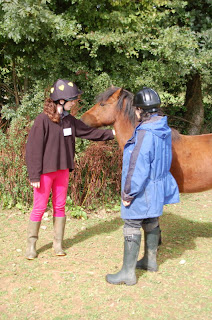
Here are a few more photos from the September DASH course, courtesy of Kay Wisker (thank you Kay!). DASH have asked me to run some more equine courses for them, starting in spring next year, so there will be another opportunity to do the "Guide to Horse and Pony Management" course as well as a couple of new course options...



Tuesday, 14 September 2010
Course for the Devon Association of Smallholders
 Last Saturday (11th September) Faye ran her course "A Guide to Horse and Pony Management" for members of the Devon Association of Smallholders. Nine participants from all over Devon came to Horseford Farm to learn about different aspects of equine care - from setting up stabling facilities to basic equine healthcare, worming and feeding.
Course participants included horse owners, members considering having equines on their smallholding, and those about to take delivery of their first horses and ponies. It was a lovely group and it was really nice to have a mixture of teenagers and adults. Everyone participated in activites and Faye was on hand to answer questions all day.
The course is designed to cover conventional ways of horse keeping as well as options such as barefoot/shod or chemical wormers/herbal wormers. By giving information about different options, owners can go away and decide what suits them and their horses best.
Faye received excellent feedback from participants for her teaching. Here's some of the feedback from the day:
"Good comprehensive course for complete beginners and "old hands". The whole course was presented in an interesting and informative way".
"Excellent course overall".
"I found out loads more and has been a confidence boost that what I am doing with my pony is OK".
"All great but superb being able to incorporate all the different individual requirements...Given me an idea of other information to look into re barefoot/shod, feeding herbs, natural wormers/conventional types. Thank you so much".
"Thought it was well-balanced and thought out. Good general information".

Individual lessons for confidence building
As well as running one day courses in confidence building, Faye also offers individuals private lessons. Not everyone likes learning in groups, and Faye offers 1:1 private lessons, either at Horseford Farm, or at the client's facilities. Confidence building is one of our specialities. We achieve results because we take time to understand the people and the horses, we equip our students with the knowledge and skills that they need, and we teach at a pace that suits them. Teaching practical aspects "person to person" is really important, and means that people already feel more confident about what they are doing before they start working with the horses and ponies.
Faye received excellent feedback from her teaching last week..."Well communicated by Faye in a relaxed, calm environment. No pressure on me, unhurried, a fun, positive experience! I enjoyed the mix of theory and practical tuition and being able to put skills into action, initially with Faye and then with Bobby, Rocky and Frodo! A great day which left me feeling "Yes, I can do this"! In one session I feel that I have learnt so much. Thank you".
Faye received excellent feedback from her teaching last week..."Well communicated by Faye in a relaxed, calm environment. No pressure on me, unhurried, a fun, positive experience! I enjoyed the mix of theory and practical tuition and being able to put skills into action, initially with Faye and then with Bobby, Rocky and Frodo! A great day which left me feeling "Yes, I can do this"! In one session I feel that I have learnt so much. Thank you".
Subscribe to:
Posts (Atom)
.JPG)