Tuesday, 13 July 2010
Getting ready for Pony Picnicing
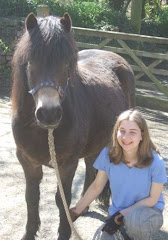
Here we are as a team - trek leader Faye in the centre with ponies (from left) Rocky, Muddy, Frodo and Bobby. These ponies all take part in our Understanding Horses courses - each are completely different characters and have their own personalities. Muddy once known for his bolshiness, and for being a "pushy pony", is now reformed and is one of our easy to lead, reliable ponies who is very good in traffic.
Monday, 5 July 2010
"Pony Picnics" is launched!

We are very excited to announce the launch of our new project called Pony Picnics! Come and enjoy an afternoon adventure, with our friendly pack ponies, in the beautiful Devon countryside.
It's a great way to have fun, relax and unwind. Learn to lead your pony, and then we'll guide you on a circular route along the quiet country lanes. You can choose to enjoy a riverside picnic en-route, or delicious Devonshire cream tea on return...or why not try one of our shorter summer evening walks?
No previous experience of horses is necessary, we provide all the necessary safety equipment and there is always an experienced helper for each pony on the trek.
Our excursions are perfect for families, individuals, social groups and, especially, for childrens' parties.If you've been on one of our Understanding Horses courses and would like a refresher, or more practice with our ponies, this is an extra opportunity for you to continue to build your confidence!
.
To find out more about Pony Picnics and our pony trekking adventures, please visit http://www.ponypicnics.com/, or contact Faye Stacey on 01884 251251.
Sunday, 4 July 2010
Advice for horse riders, horse owners and tractor drivers - keeping safe on the roads
Being blessed with such a beautiful summer this year, it's encouraged all of us to make the most of the sunshine. At some stage, it's inevitable that horses and tractors are going to meet each other out on the Devon lanes. For many horses, the only time they will ever encounter tractors and large vehicles will be when they are out on the roads and country lanes. Some of these machines can seem very scary the first time they are encountered.
If drivers of large vehicles and horse owners take a few simple steps, everyone can stay safe, and horses can learn that big machines aren't a problem.
Horse owners:
Drivers of tractors and large vehicles:
If drivers of large vehicles and horse owners take a few simple steps, everyone can stay safe, and horses can learn that big machines aren't a problem.
Horse owners:
- Whether you are leading, riding or driving your horse or pony, make sure you are wearing flourescent gear to make yourself visible to all road users.
- Make sensible decisions on how it is best to pass a vehicle. It is better to face vehicles to pass them. Decide whether:
- There is plenty of room (at least a car's width) to pass the vehicle where it is in the lane.
- You need to go back along the lane to a layby or wider section.
- You need to use hand signals to ask drivers to stop or slow down.
- Getting off and leading your horse might be the best way to help your horse pass a vehicle.
- Have a positive attitude - being confident that you can deal with a situation will really help your horse. Horses should not be beaten or hit for refusing to pass a scary vehicle - this will lead to an association of fear with the situation.
- Always thank drivers for their considerate driving.
- After you have passed a tractor or large vehicle, turn to face it, and as it starts to move away from you, let your horse follow it for a few strides. This will help to create a more positive association for your horse.
Drivers of tractors and large vehicles:
- Approach horses slowly and with care, and always stop to allow horses to pass you. Stopping will always be the safest option.
- If you are following a horse which is moving towards the nearest layby or wider part of lane, keep well back to avoid the horse feeling it is being chased. If you can see the horse's head bending to the left or right to keep an eye on your vehicle, or that it is starting to rush and panic, this means that you are too close. Just back off a bit. This will prevent a situation from escalating.
- Give a horse, or pony, at least the same amount of room you would allow for a car to pass alongside your vehicle in a lane.
- Be aware that any load with flapping plastic on the back will be a challenge for any horse to pass. Again, stopping will help to minimise the movement of the plastic.
- Heed the hand signals of horse handlers and riders.
It's often forgotten that under UK law, horses have right of way over traffic on the roads. Whilst this shouldn't be abused, the highway code clearly states "When passing animals, drive slowly. Give them plenty of room and be ready to stop. Do not scare animals by sounding your horn, revving your engine or accelerating rapidly once you have passed them. Look out for animals being led, driven or ridden on the road and take extra care... Look out for horse riders’ and horse drivers’ signals and heed a request to slow down or stop."
If you need help to get your horse more confident around traffic, please consider one of our Understanding Horses courses http://www.understandinghorses.co.uk/courses.html
Sunday, 13 June 2010
Horse handling for the less confident person
We had lovely weather on Saturday for our popular course "Horse handling for the less confident person". This confidence building day is about learning how to be in be control of horses and ponies -whether they are loose, whether we are interacting with them in small/enclosed spaces, or if we are leading them.We always tailor the course towards the individual needs of the participants and the particular issues they would like to address. On this course, one of the special topics we covered was catching the "difficult to catch horse or pony", which is one of my favourite subjects. Once people learn to understand horse body language, and understand how their own human body language affects the horse, catching is no longer a problem. Being able to go out and interact with our herd of ponies means that people can practice their skills. Faye helps students to interpret the signals from the ponies, and helps students to perfect their techniques.
.
We finished the day by taking Muddy for a walk - this helped to bring all the day's teaching together. Everyone was able to confidently handle him, even though Muddy was an unfamiliar pony to them, and participants were able to deal with different scenarios, such as what to do if your pony refuses to move...and how to safely pass tractors and traffic.
We received excellent feedback ratings about all the aspects of the course - for the quality of the teaching, the theory and practical content, and the overall experience on the day.
Feedback comments "Great to be able to put it all into practice. Good balance of theory and practical. Certainly made us think about how our actions give reactions to the ponies".
Photos from the day: above - Faye teaching in the yard, with pony Bobby and course participant Louise listening to the instructions! Below - (left) putting the theory and techniques into practice on each other, before trying it with the ponies. (upper right) A very nice example of how to ask a pony to take a few steps backwards. (Lower right) Returning to the yard with Muddy after taking him for a walk to put the day's teaching into practice.

Sunday, 23 May 2010
Understanding Horses and the Devon Association of Smallholders (DASH)
Whilst I have been busily working on the new UH project, I've also had confirmation that the Devon Association of SmallHolders (DASH) are going to be offering an Understanding Horses course in this year's training schedule.
DASH members are being offered the opportunity to enrol on "A guide to horse and pony management", and a date has been set for Saturday September 11th 2010. The day is designed for anyone who is thinking of taking on a horse or pony (for conservation grazing, working on the small holding or for leisure purposes) and we will cover topics such as stable and field set-up and management; feeding; worming; hoof and health care - including how to recognise and avoid common health problems. Full details will be published in the June issue of the DASH magazine and, from June, on the DASH website http://www.devonsmallholders.co.uk/training.html
Monday, 17 May 2010
An exciting new project is on its way...
The last week or so, I've been very busily engaged in preparing to launch an exciting, new project. All will be revealed very soon, but perhaps a few clues...
...it definitely involves ponies, including these handsome chaps and their friends,


...the beautiful Devon countryside,
...and people enjoying a wonderful family day out...
...And it should be launched in the next few weeks. Keep an eye on the blog for more details...
...it definitely involves ponies, including these handsome chaps and their friends,
...the beautiful Devon countryside,
...and people enjoying a wonderful family day out...
...And it should be launched in the next few weeks. Keep an eye on the blog for more details...
Friday, 7 May 2010
Restricting grazing, weight management and laminitis prevention
Having been out to see two little ponies today, I must stress the importance of restricting grazing for ponies and managing their weight. Native ponies are designed for rough grazing, something that is very rarely available to them nowdays. Most of us own improved pasture land with lush, green grass and it's too good for little ponies. If unrestricted with their grazing, ponies put on weight very quickly, and all too often this results in laminitis.
Restricting grazing is the kindest thing you can do to keep your pony healthy. Ponies need a high fibre, low sugar diet and you can supplement their diet with soaked hay to ensure they have enough fibre going through their system. They should not be starved. I recommend owners use a weigh tape so they can monitor and manage the weight of their horse or pony throughout the year.
If you are in the unfortunate situation where your horse or pony is displaying signs of laminitis, you must take your horse off the grass immediately. Filling a stable with stable shavings can provide a comfortable surface for them to stand on. Soak hay thoroughly to remove sugars and there are hay replacements (designed specifically for laminitics) available in feed stores. Make sure you cut out feeding carrots and sugary snacks . Contact your vet or farrier/hoof care practitioner for advice.
Restricting grazing is the kindest thing you can do to keep your pony healthy. Ponies need a high fibre, low sugar diet and you can supplement their diet with soaked hay to ensure they have enough fibre going through their system. They should not be starved. I recommend owners use a weigh tape so they can monitor and manage the weight of their horse or pony throughout the year.
If you are in the unfortunate situation where your horse or pony is displaying signs of laminitis, you must take your horse off the grass immediately. Filling a stable with stable shavings can provide a comfortable surface for them to stand on. Soak hay thoroughly to remove sugars and there are hay replacements (designed specifically for laminitics) available in feed stores. Make sure you cut out feeding carrots and sugary snacks . Contact your vet or farrier/hoof care practitioner for advice.
Subscribe to:
Posts (Atom)